
Did you know that there are over 100,000 species of fungi in the world? From the mushrooms we eat, to those
that cannot be seen with the naked eye, identifying them is no easy feat. Yet it is crucial to identify the species accurately given that there are over 4,000 clinically important species that may cause life-threatening diseases.
The Singapore General Hospital’s (SGH) Department of Microbiology and Synapxe’s Data aNalytics and AI department have collaborated to develop FungAI, one of the world’s first computer vision Artificial Intelligence (AI) model that can identify fungi species from patient specimens.
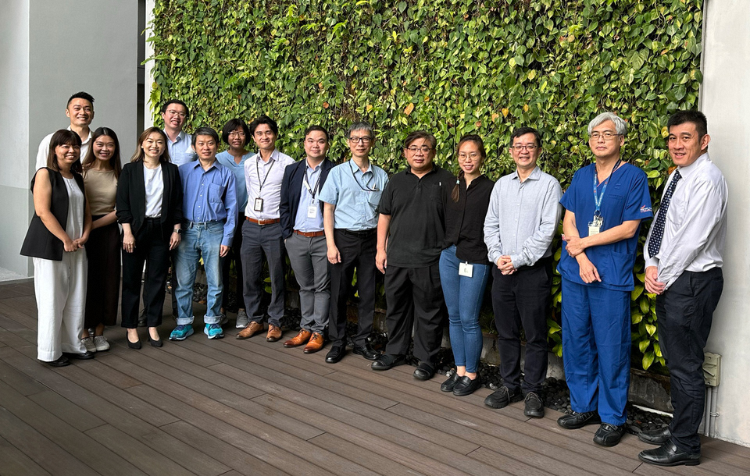
Innovating fungi identification
The procedure to identify fungi is lengthy and heavily reliant on manual processes with a turnaround time of about four days. The project team designed a solution that could halve the time required, allowing for earlier diagnosis and treatment intervention for patients.
In October 2019, SGH and Synapxe began experimenting with over 8,500 images collected over two years involving five species of commonly encountered fungi. Through the experiment, it demonstrated that the turnaround time for identification could be reduced to just two days, with an accuracy of 80-90%.

The team endeavours to scale the experiment into a proof-of-concept, focusing on a broader range of fungi species, an efficient data collection process and a simple user interface.
If successful, FungAI may be deployed in the SGH mycology laboratory to address the shortage of skilled expertise in this area by allowing junior laboratory staff to identify commonly encountered fungal species by simply uploading a microscope image into the AI model and easing trained staff for complicated fungal cases.
“While most AI efforts in this area have leaned on established methods like Deep Learning Convolution Neural Network (CNN), our study explores the potential of Vision Transformer (ViT), a newer and promising approach. It's like adding a new tool to the healthcare toolbox. We found that combining the strengths of both CNN and ViT through an ensemble technique enhances the accuracy of fungal classification, paving the way for more effective treatments.”
- Dr Goh Han Leong, Senior Principal Specialist, Platform Services (Data aNalytics & AI), Synapxe
“With the rise in antifungal resistance, it is important to identify fungal species at a faster rate for earlier appropriate intervention. The FungAI technology aims to empower laboratories with limited resources by reducing the reliance on skilled workers which may take many years of training and experience to be proficient in the specialty. This is especially important given the difficulties of getting trained staff in both the current and future job market.”
- Dr Tan Yen Ee, Senior Consultant, SGH Department of Microbiology
